 TalkWorld
About TalkWorld
Where TalkWorld came from, what it was like in the 1990s, and how it was brought back.
What TalkWorld is
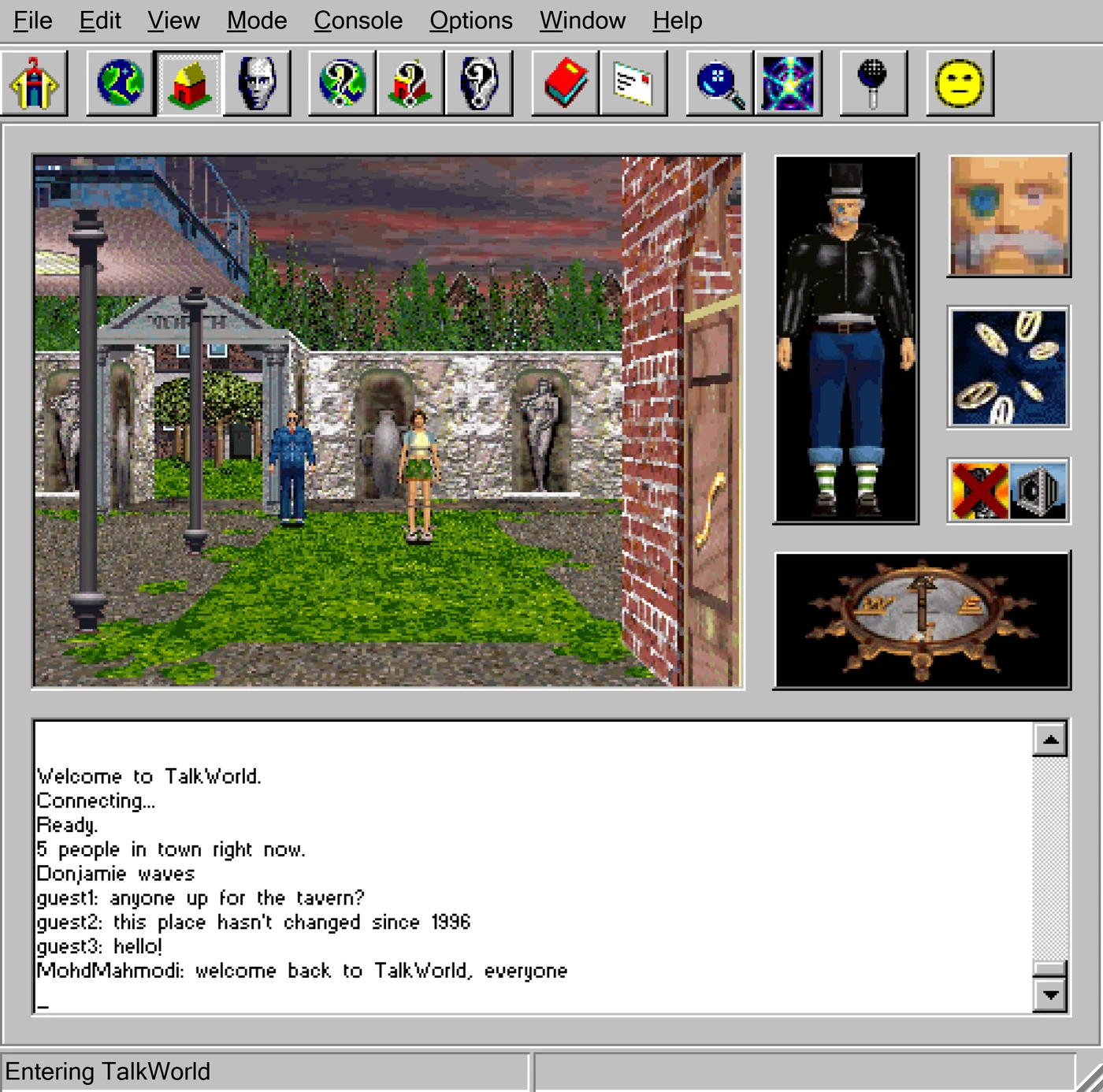
TalkWorld is a Windows program from 1996. When you open it, you appear in a small 3D town as a character, and the other characters you see are real people somewhere else in the world.
You can walk up to people and type to them, shout so the whole town hears, whisper to one person, or hold a button and talk with a microphone. The town has a tavern, a church, a cinema, a museum, a town hall, a sports centre and a science centre, and most of them have a message board where people leave notes.
The game's own help file describes it as a "virtual chat environment".
History
These dates come from the game's own files and from copies of the old websites kept by the Internet Archive. Where a date isn't certain, we say so.
| 1996 | Etchinghill Studios makes TalkWorldA small studio in Kent, England, finishes TalkWorld after more than seven months of work. It's the company's first release, and the program's About box reads "Copyright 1996/97". One archive lists a release date of 1 December 1996, but we haven't been able to confirm it. |
|---|---|
| 1997 | A website and a second gameetchinghill.com goes online in January 1997 as the home of TalkWorld. The studio also announces Lands of Legend, an online adventure game planned for late 1997. We haven't found any sign that it was released. |
| Late 1990s | Guests and subscribersThe download is free and about 3 MB. Guests can walk around and listen, but they all look the same and can't use voice. A subscription gives you a unique name, your own appearance, a TalkWorld email address and the ability to speak. The game keeps track of paid online time. |
| 2000 | talkworld-online.comThe studio advertises jobs from offices in Maidstone, Kent. By December, talkworld-online.com describes TalkWorld as "free 3D voice chat", and registration is marked as optional. |
| 2001 | The last updateVersion 1.1 of the help file is dated 5 February 2001 and lists Windows 95, 98, NT and 2000. This is the last known version of the game. |
| 2002–2007 | The servers go quietBy March 2002, etchinghill.com is a parked domain. talkworld-online.com stays up until spring 2007 and then changes hands. We don't know the exact date the game servers were switched off. |
| 2020s | People still remember itCopies of the game are kept in software archives. On one of them, players ask whether anyone can still meet in town, and in 2025 someone starts a thread asking for it to be revived. |
| 2026 | Back onlineA new server, a browser version and a Windows launcher go live at talkworld.org. The original program connects to the new server without any changes to the game itself. |
"Bare-chested men wandering around in kilts and furry rabbit slippers."
In the 1990s
TalkWorld needed Windows 95, 8 MB of memory, DirectX and a modem of at least 9600 bps. The studio recommended a Pentium and a full-duplex sound card, so that you could talk and listen at the same time.
The help file pointed out that a long international phone call was expensive, while the internet was charged at local rates, so talking to someone abroad in TalkWorld cost very little.
What's different now
- Everything is free, and guests can change their appearance and use voice chat.
- You can play in a browser or on a phone as well as on Windows.
- Private rooms give a group of friends their own copy of the town.
- Voice goes through the server, so nobody can see anyone else's IP address.
- Anyone can build a town of their own in the Map Editor, with stairs, skies and a town map, and make a room with it.
- Optional high quality graphics, three screen layouts, and Linux downloads.
How the revival works
The original server software wasn't available, so it had to be rebuilt from the one thing that was left: the 1996 program.
- Working out the protocol. We took talkworld.exe apart to learn every message it sends to the server and what it expects back.
- A new server. The server understands those messages, so the original program connects to it as if nothing had changed. It also handles accounts, mail, message boards and private rooms.
- The browser version. The 3D engine, menus and windows were rebuilt to match the original, using the game's own art, fonts and sounds.
- Voice between both. The browser version uses the same voice format as the 1996 program, so Windows and browser players can hear each other.
- The launcher. A small Windows program that lists the rooms, signs you in and starts the game, in a new game window or in the original 1996 program. It keeps itself up to date. Every release is listed on the Updates page.
- The Map Editor. Custom towns use the same map files as 1996, so they are built from the game's own pictures and can be played as easily as the original town.
- Safety. The game's built-in updater could replace files on your computer, so the new server never uses it. It also never shares players' IP addresses.
The revival team
Mohd Mahmodi
Server, browser version and launcher
Software engineer who builds web apps, iOS apps and real-time systems. Wrote the new TalkWorld server, the browser version and the Windows launcher.
mohdmahmodi.com · X · GitHub
Credits
TalkWorld was made by Etchinghill Studios in Kent, England, between 1996 and 2001. The town, the characters, the sounds and the program are theirs. This revival is a free fan project and isn't connected to Etchinghill Studios.
The Windows download includes DDrawCompat by narzoul, an open-source fix that helps old DirectDraw games run on current versions of Windows.
With High quality graphics on, chat text uses the Arimo, Tinos and Oswald fonts from Google Fonts, under the SIL Open Font License. They are shaped like the game's three original chat fonts.
Did you play it back then?
If you worked at Etchinghill Studios or played TalkWorld in the 1990s, we'd be glad to hear from you. Old screenshots, manuals, magazine reviews and stories would all help fill in the history above. You can reach us through the links in the team section.